White Holes: The Universe's Enigmatic Opposite of Black Holes
White Holes: The Universe's Enigmatic Opposite of Black Holes, Unveiled
Published on: May 24, 2025 | Written by Science by Rao
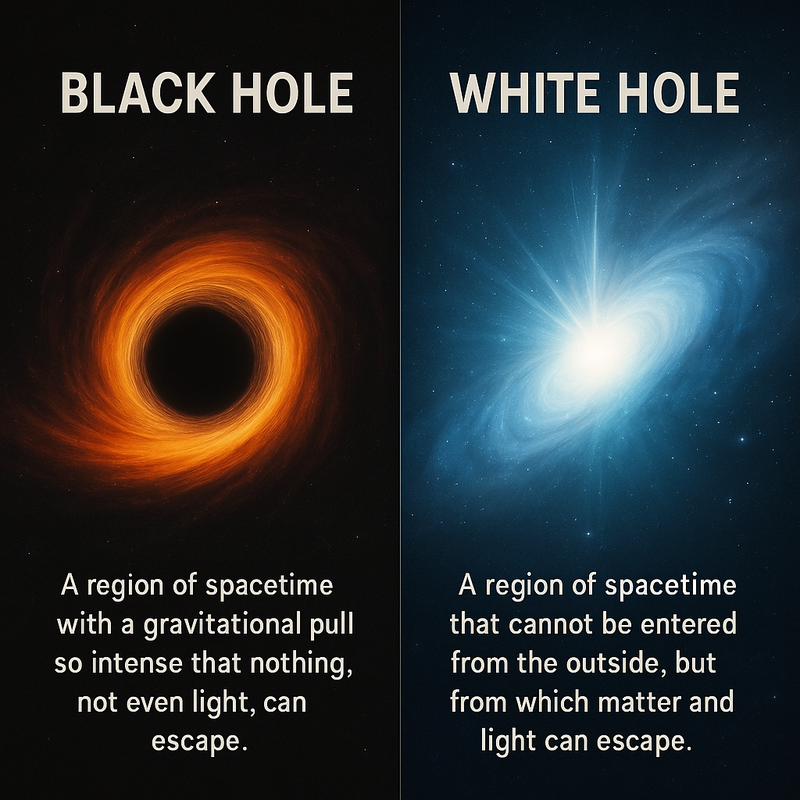
Figure 1: A visual representation contrasting the inward pull of a black hole with the outward expulsion of a white hole.
Abstract: Journey into the mind-bending realm of white holes, the theoretical antithesis of black holes. Explore their mathematical origins, their paradoxical properties, and the reasons why, despite their allure, they remain purely speculative. This post delves into the profound implications of white holes for our understanding of spacetime, gravity, and the universe's ultimate mysteries.
1. Black Holes: The Cosmic Absorbers (A Quick Refresher)
To fully appreciate the bewildering concept of a white hole, we must first firmly grasp the nature of its more famous sibling: the black hole. Predicted by Albert Einstein's General Theory of Relativity, a black hole is not merely a region of immense gravity, but a profound distortion of spacetime.
- The Anatomy of Oblivion: At its core lies a singularity – a point (or ring, for rotating black holes) where matter is compressed to an unimaginable degree, and the known laws of physics dramatically break down. Surrounding this singularity is the **event horizon**, a boundary beyond which nothing, not even light, can escape. It's the ultimate point of no return. Once anything crosses this horizon, it is irrevocably doomed to fall towards the singularity.
- A Confirmed Reality: Unlike their theoretical counterparts, black holes are observed and verified cosmic entities. Evidence ranges from indirect observations like the superheated gas in **accretion disks** emitting intense X-rays, to the detection of **gravitational waves** from colliding black holes by observatories like LIGO and Virgo. The groundbreaking images from the **Event Horizon Telescope** (e.g., M87* and Sagittarius A*) have directly revealed the shadows of their event horizons, confirming their existence beyond doubt.
- Time's Unyielding Arrow: A black hole's event horizon is fundamentally **future-directed**. This means that for anything crossing it, the singularity lies in its inescapable future. It is a cosmic one-way street, where time's arrow points relentlessly inward.
2. What Are White Holes? Understanding the Basics and Their Theoretical Roots
The concept of a white hole isn't born from fanciful imagination but arises directly from the mathematical elegance of **Albert Einstein's General Theory of Relativity**. Specifically, when physicists analyze the solutions to Einstein's field equations that describe the spacetime around a non-rotating, uncharged black hole – known as the **Schwarzschild metric** – they discover a profound and unsettling symmetry.
- The Power of Time Reversal: Many fundamental laws of physics exhibit time-reversal symmetry; if you reverse the direction of time ($t \rightarrow -t$) in the equations, they still hold true. When this principle is applied to the mathematical description of a black hole (where matter collapses inward), the time-reversed solution describes something entirely different: a region from which matter and energy are violently expelled outwards. This time-reversed black hole is precisely what we define as a **white hole**.
-
Anatomy of an Erupting Horizon: By definition, a white hole is:
- An Anti-Gateway for Ingress: Its defining feature is an event horizon that, unlike a black hole's, can *only* be crossed outwards. Nothing from the external universe can ever enter a white hole's event horizon. It acts as an impenetrable barrier, repelling all incoming matter and energy.
- A Source of Outgoing Matter and Energy: Anything that exists within the white hole's event horizon is destined to be violently propelled outwards, away from its central singularity. Imagine a cosmic fountain, perpetually spewing forth cosmic material that could never have entered from our observable universe.
- A Past-Directed Event Horizon: For any particle emerging from a white hole, its event horizon lies in its inevitable past. It's the boundary from which it emerged, moving inexorably outwards.
-
White Holes vs. Black Holes: A Surprising Comparison:
Feature Black Hole White Hole Function Cosmic vacuum cleaner (absorbs) Cosmic geyser (expels) Event Horizon Point of no return for entering matter Boundary that prevents entry for incoming matter Singularity In the future of falling matter In the past of emerging matter Time's Arrow Inwardly directed Outwardly directed Reality Observed and confirmed Purely theoretical (never observed)
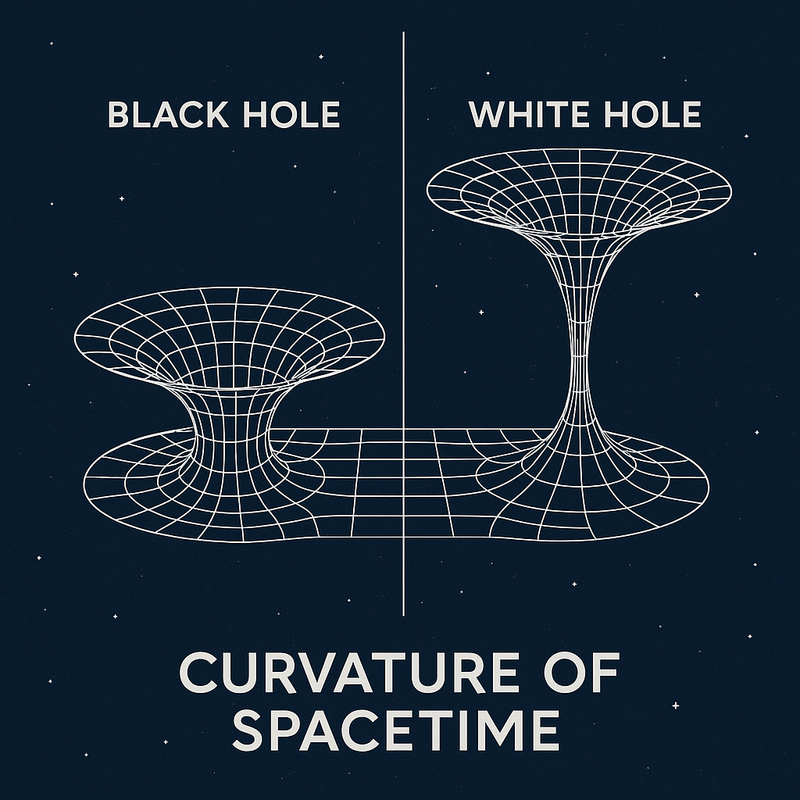
Figure 2: An illustration of spacetime curvature, contrasting the inward pull of a black hole with the outward push of a white hole.
3. Could White Holes Really Exist? The Scientific Roadblocks and Instability
Despite their elegant mathematical foundation from General Relativity, white holes remain firmly in the realm of theory and science fiction. We have **never observed a white hole**, and there are several profound reasons why the scientific community largely believes they are unlikely to exist in our universe.
- The Formation Problem: A Lack of Mechanism: This is arguably the most significant hurdle. Black holes form naturally through the gravitational collapse of massive stars. There is no known physical process in our universe that could naturally lead to the formation of a white hole. How would a time-reversed collapse – an "un-collapse" – spontaneously occur? While the equations allow for them, they don't provide a physically realistic pathway for their creation from the conditions we observe in the cosmos. The singularity of a black hole lies in its future, whereas the singularity of a white hole would lie in its past, implying a "beginning" that defies standard astrophysical formation.
- Extreme Instability: Even if a white hole could somehow miraculously come into existence, theoretical calculations suggest they would be incredibly fragile. Any minute perturbation, such as a single photon or a tiny speck of dust, attempting to approach its event horizon from the outside, would immediately destabilize it. This instability would likely cause it to rapidly collapse, perhaps transforming into a black hole or simply dissipating, unable to maintain its paradoxical structure in a universe teeming with matter and energy.
-
Violation of the Second Law of Thermodynamics: This is a major physical objection rooted in one of the most fundamental laws of our universe. The Second Law of Thermodynamics states that the total entropy (or disorder) of an isolated system must always increase over time.
- A black hole is an **entropy maximizer**: it absorbs matter and energy, increasing the overall disorder of the universe by consuming information.
- A white hole, by constantly expelling matter and energy without absorbing any, would seemingly **decrease the entropy** of its local region of influence. This scenario fundamentally contradicts the observed arrow of time and the natural tendency towards increasing disorder in our universe, making their sustained existence highly improbable.

Figure 3: An artistic representation of a white hole's inherent instability, showing its erupting nature and potential fragility.
4. White Holes, Wormholes, and the Big Bang: Intriguing Cosmic Connections
While their direct observation remains elusive, the theoretical possibility of white holes sparks intriguing connections to other speculative and fundamental concepts in cosmology, pushing the boundaries of our cosmic understanding.
-
Wormholes (Einstein-Rosen Bridges): A Spacetime Shortcut?
The same mathematical framework that gives rise to white holes also underpins the concept of **wormholes**, or **Einstein-Rosen Bridges**. A wormhole is a hypothetical topological feature of spacetime that could act as a "shortcut" connecting two widely separated regions of spacetime, or even two different universes.
Some theoretical models suggest a wormhole could have a black hole at one entrance (a region you can enter) and a white hole at its exit (a region you can only leave). Imagine stepping into a black hole in one galaxy and instantly emerging from a white hole in another, distant galaxy! However, for such a wormhole to be traversable and stable, it would require the existence of "exotic matter" with negative energy density, which, like white holes themselves, remains purely theoretical.
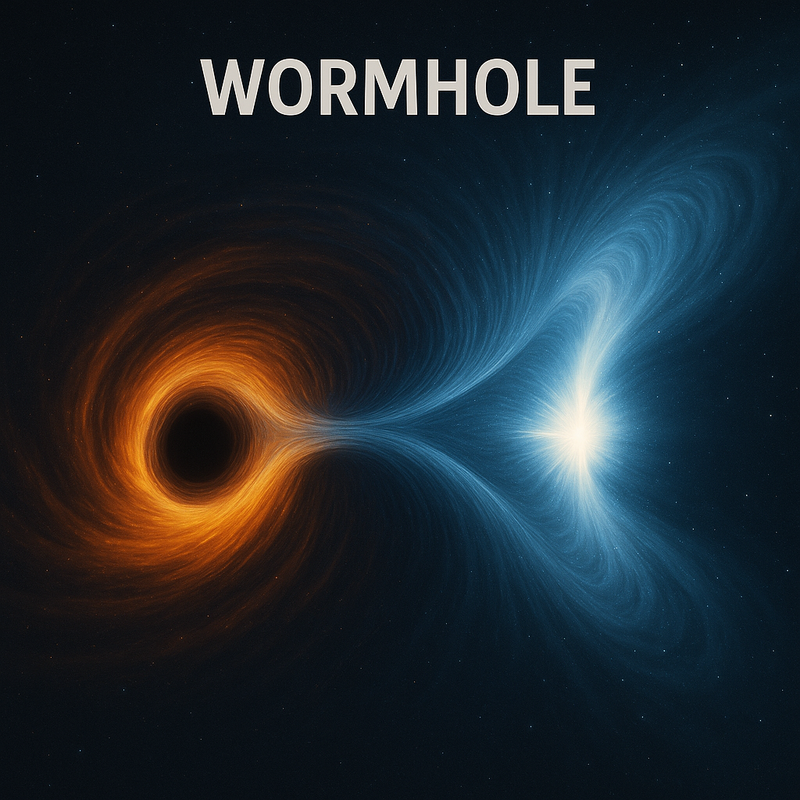
Figure 4: A simplified diagram showing a wormhole, a theoretical bridge linking a black hole entrance to a white hole exit.
-
The Big Bang as a White Hole? A Radical Hypothesis:
One of the most audacious and speculative ideas is the notion that the Big Bang itself – the singular event that birthed our entire universe – could be interpreted as a form of a white hole. In this highly unconventional view, our universe emerged from an infinitely dense, hot state that was expanding outwards, fundamentally preventing anything from "outside" its initial causal horizon from entering.
This idea, explored by physicists like Nikodem Popławski, provides a poetic symmetry to the black hole concept, where matter emerges from a singularity rather than collapses into one. However, it's crucial to stress that this is far from a mainstream scientific theory and faces numerous challenges, including reconciling it with established cosmological models and observational evidence like the Cosmic Microwave Background. It remains a fascinating, albeit unsupported, thought experiment about the universe's ultimate origin.
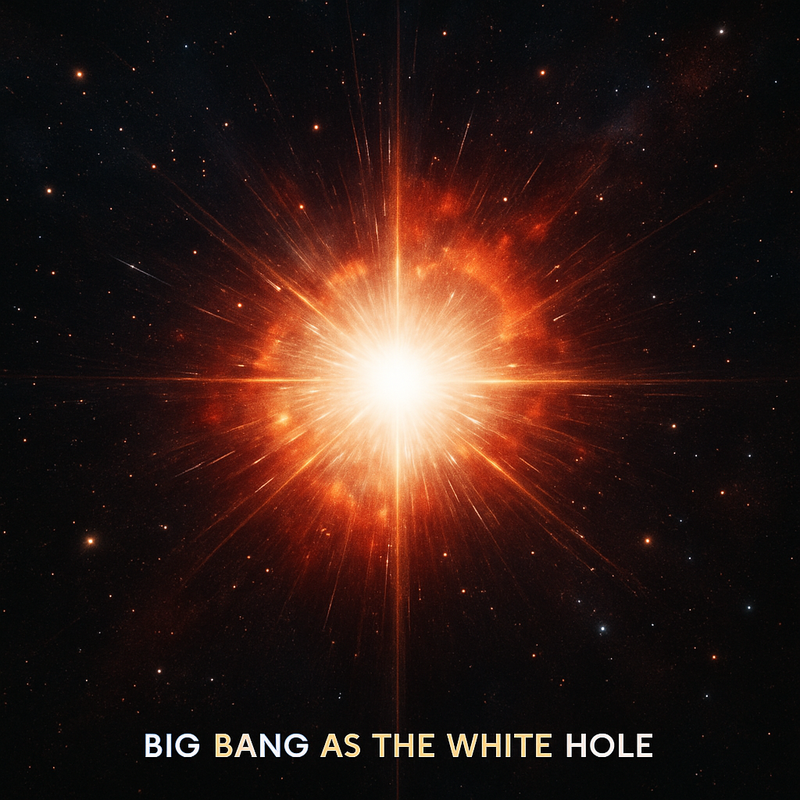
Figure 5: An artistic rendering depicting the Big Bang as a potential white hole-like event, expelling matter and energy into the early universe.
5. Conclusion: Pushing the Boundaries of Physics and Imagination
White holes stand as a testament to the profound power and sometimes bewildering implications of Albert Einstein's General Theory of Relativity. Born from the very same elegant equations that describe the black holes we observe, they represent a fascinating, time-reversed paradox – a cosmic fountain from which matter perpetually emerges. While their existence remains purely hypothetical, challenged by the absence of a known physical formation mechanism, their inherent instability, and fundamental laws of thermodynamics, their concept continues to serve a vital role in theoretical physics.
White holes push physicists to explore the ultimate limits of spacetime, the nature of singularities, and the very arrow of time. They remind us that the cosmos holds mysteries far stranger than fiction, compelling us to consider scenarios that defy intuition. Could white holes be the key to understanding dark matter or dark energy? Will we ever observe one in real-time? The ongoing quest to unify general relativity with quantum mechanics, to forge a theory of quantum gravity, may one day shed more light on these paradoxical cosmic objects – perhaps definitively ruling them out, or, more thrillingly, revealing a deeper connection to the fabric of reality than we currently comprehend, as we continue to unravel the universe's most profound secrets.
---References & Further Reading (Resources from which information was gathered)
The information for this post was compiled from various reputable sources in theoretical physics and cosmology, including:
- Carroll, S. M. (2004). *Spacetime and Geometry: An Introduction to General Relativity*. Addison-Wesley. (A foundational textbook on General Relativity)
- Hawking, S. W., & Ellis, G. F. R. (1973). *The Large Scale Structure of Space-Time*. Cambridge University Press. (A seminal work on spacetime and cosmology)
- Frolov, V. P., & Novikov, I. D. (1998). *Black Hole Physics: Basic Concepts and New Developments*. Kluwer Academic Publishers. (Comprehensive resource on black hole theory)
- Giddings, S. B. (2020). "Black hole information, 2020: Report on the current status." *Reports on Progress in Physics*, 84(2), 026001. (For contemporary understanding of black hole information paradox)
- Popławski, N. J. (2010). "Matter-antimatter asymmetry and dark matter from torsion." *Physics Letters B*, 694(3), 181-185. (An example of research exploring the Big Bang/White Hole connection, though it's important to note this is a highly speculative area)
- NASA (National Aeronautics and Space Administration) and ESA (European Space Agency) official websites for general black hole information and astronomical observations.
- Various peer-reviewed articles and scientific discussions on theoretical cosmology.


Comments